
 |
| Home |
| The Books |
| Newsletter |
| About the Author |
| Reviews |
| Articles & Workshops |
| Links & Contacts |
 |
Notes and News
Spring 2008
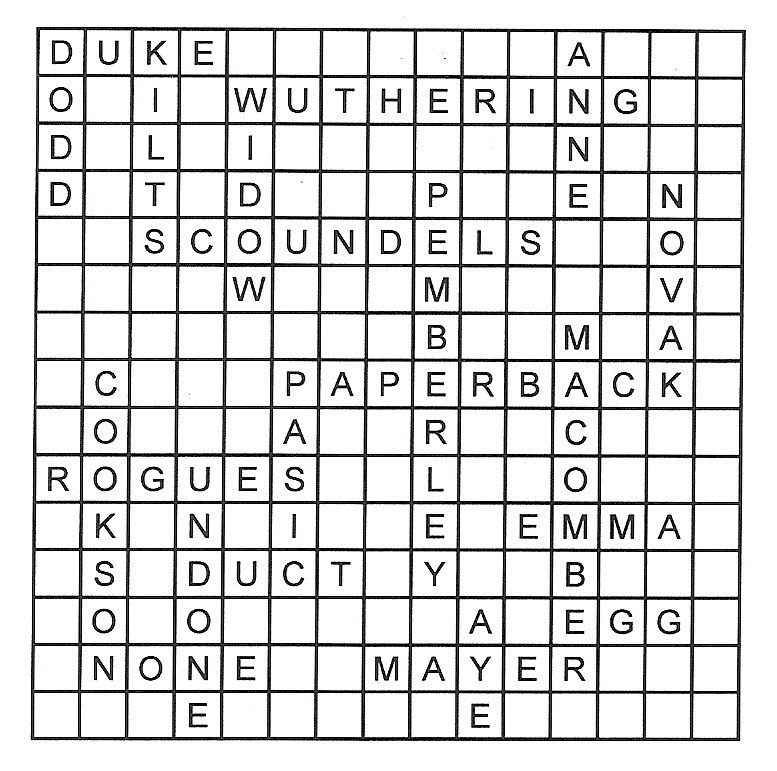
Crossword solution is at the bottom of this page
News bites:
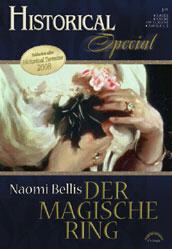 Step
into Darkness has been released as Der magische Ring by Cora
Verlag, the German romance publishers. They’ve released it as the first of
their redesigned “Historical Special” line, which features historical
romances with a twist. What a lovely cover they gave it!
Step
into Darkness has been released as Der magische Ring by Cora
Verlag, the German romance publishers. They’ve released it as the first of
their redesigned “Historical Special” line, which features historical
romances with a twist. What a lovely cover they gave it!
Congratulations to the winners of my website give-away contests this spring. I was delighted with the response and thank all of you who entered – participation like that makes running a contest fun.
Check out my blog at Live Journal! http://naomibellis.livejournal.com/ or come see me at MySpace (www.myspace.com/naomibellis) or, of course, Facebook!
It’s been a very busy spring. Some of it’s been real-life, day-job stuff, and some of it (a lot of it) has been collaborating with Signet around what comes next from my desk and onto the shelves. Do you ever wonder where you, the readers, come in those discussions? You’re front and center! All the emails I received asking for Gabriel’s story certainly counted, so thank you, thank you, thank you! It just goes to show it’s worth speaking up for what you like.
Here’s another opportunity to register your opinion. I’ve included a new puzzle feature this time. What do you think?
Maybe I’m just easily amused, but I wanted to see if I could come up with something a bit different. There’s very nice software for this sort of thing, but I couldn’t find a program that let me do a grid completely from my own clues – so it was off to Excel. Hey, at least it’s different from my usual journals and ledgers! Counting the squares turned out to be a bit like cross stitch—inevitably something (phone, cat, well-meaning observer) made me lose track, so these are the most thoroughly-counted squares on planet Earth. I hope you enjoy it! The solution is below
Romance Crossword
ACROSS
1. There were far fewer of these aristocrats than romance titles would have us believe.
2. Adjective describing a high, gothic place
3. Well-known title: Lord of ________ (Very Naughty People)
4. The type of writer the song thinks we would like to be.
5. According to Jo Beverley, within their company one needed rescuing, but another returned.
6. One of Jane’s organizing females
7. We don’t know if this kind of tape fixes plot holes, but it takes care of everything else.
8. When referring to geese, it means nothing
9. The number of occasions when true love runs smooth
10. This thriller writer has co-authored books with a favourite author of romantic comedy
DOWN
1. Her first novel was Candle in the Window and now she’s heading Into the Flame.
2. She’s free and she’s merry
4. Where the pubbed hang out in the Romance Writers of America (and no, it’s not the bar)
11. Forget men in trees, we like men in ____________
12. Two of Henry’s wives.
13. Elizabeth B. went there as a tourist before she went there as a wife.
14. Runs an auction for Juvenile Diabetic Research
15. This author likes knitting and naming her books after street addresses
16. This English author of historical fiction wrote many books about struggling
with poverty and challenging family relationships.
17. Alas, I am _________
18. Yes, Captain!
|
|

|
The Early Nineteenth-Century Garden |
|
Like everything else, gardening has a history. There’s a reason you won’t find a French medieval princess skipping through a field of dahlias, and a Regency wedding festooned in August roses just not work. Most of the plant varieties available now are, relatively speaking, recent additions to our yards. Not that folks didn’t enjoy their gardens in the past. Those that could afford it sunk enormous sums of money into both the scientific and aesthetic aspects of horticulture. George II’s wife, Queen Caroline, incurred considerable debt upgrading Kew Gardens during a time when the formal style of previous years was giving way to the new naturalistic taste. Over time, Kew became the centre for research and development around economically important plants discovered during the age of exploration, such as coffee, rubber, quinine (a medicine derived from the cinchona tree), sugar, and chocolate. Some of these specimens were highly valued, and plant theft was a problem. However, not everyone had the land to create huge “prospects” of scenery, nor did they care to invest in a rubber plantation. A new kind of gardener was evolving, created by the Industrial Revolution. It is estimated that during the late eighteenth and early nineteenth centuries, 1,700,000 villas—basically nice houses with a few acres of ground—were built around the towns and cities of England. The upwardly-mobile middle class had arrived and was looking for home decorating advice. Fashionable landscapers like Humphrey Repton got rich. The focus of these more modest gardens was on individual plant species rather than sweeping views. Previously, landscapers banished flower gardens from sight lest the sudden splash of colour disrupt the natural look of the scene. Now, the early nineteenth-century garden found new directions that suited a smaller format—and that meant blooms. This newfound flower power was driven by the wealth of exotic plants brought to England by explorers. In 1804, Dahlia coccinea, Turk’s cap and the tiger lily arrived. 1816 brought the bleeding heart and Wisteria sinensis. 1825 introduced the California poppy to Britain. The list is endless and the result profound. Previously, gardens enjoyed only a brief period of blooms in the late spring. Even most roses did not produce much beyond mid-July. Now, with all these new floral varieties, it was possible to have colour from early spring till frost. Large plantings of flowers were put into island beds. These were sometimes turned into “baskets” with the addition of giant handles and low ornamental fences. More exotic and valuable plants were often displayed in pots so that they could be whisked indoors at the first hint of cold weather. There are cases where collections of potted plants were included in wills and bequeathed with as much solemnity as the family silver. With all this available, anyone with a decent plot of land could put on a display. The public became enthusiastic about “garden tours” of the great estates, picking up ideas for their own yards. They also subscribed to an increasing selection of horticultural magazines. John Loudon launched the trend-setting journal Gardener’s Magazine in 1826. Once the Napoleonic Wars ended and tourism on the continent resumed, Loudon was quick to bring back information on continental garden designs for his readers. These polished, formal landscape styles were a hit and soon replaced the naturalistic “English” gardens favored by the late 18th century. The trend stuck and high Victorian gardens show the neat regularity of Loudon’s designs. On March 7, 1804, seven men met at Mr. Hatchard’s book and coffee shop in Picadilly. This was the first unofficial meeting of the Horticultural Society. The time was ripe for a group of professionals and enthusiastic amateurs to share ideas and, within twenty years, there were 1500 members. Peacetime, middle-class wealth, exploration, and a rising interest in natural sciences conspired to turn domestic gardening from a household necessity to a pursuit worthy of a gentleman.
There is a wealth of information available on this subject, and I am indebted to a number of sources for this article. In particular: Gardens Through Time, Jane Owen and Diarmuid Gavin. (London: BBC Books, 2004) and From a Victorian Garden: Creating the romance of a bygone age right in your own backyard, Michael Weishan and Cristina Roig (New York: Viking Studio, 2004). |

June 01, 2008